



Tommy McCoy ’08 still fits in his football letter jacket 17 years after graduating from Flint Hill. While some things have stayed the same, much has changed. Upon graduating from James Madison University (JMU) in 2014 with a Bachelor of Science in biology, he planned to go to medical school. Instead, he took a position at his family’s waste removal company, Champion Services — a move that began his trajectory into the startup world. Once he identified his passion for entrepreneurship, he took the ball and is still running with it.
Serving as vice president of business development, Tommy noticed a logistics pain point for clients with immediate needs and saw an opportunity to innovate. In 2017, he teamed up with a fellow JMU alum, Abhishek Luthra (a connection made through FH classmate Anisha Sharma’s ’09 cousin, Krish Kapani) to launch the startup HaulShare, a digital waste brokering platform connecting companies and individuals to local haulers for pickup needs.
At 9:18 a.m. on HaulShare’s launch day, their first customer requested that a couch be removed — 30 minutes later, a hauler arrived to take it away. Tommy and Abhishek started their company with only a few haulers and faith in what they built. Customer satisfaction proved them right. “The value was so obvious to customers that they wouldn’t do it any other way after that,” Tommy recalls. “If you can imagine, waiting a week to get a sofa removed, and you reduce that time to 30 minutes, it’s a life-changer.”
Today, HaulShare’s operations span the East Coast, where it manages a network of approximately 75 haulers who mainly service property management companies. But for Tommy, the true measure of HaulShare’s success is found in the personal hauling partner testimonials. The first hauler brought onto the HaulShare platform had never taken his child on vacation until the partnership brought more business. Now, they take that vacation every year. “When you have conversations like that, your worldview evolves. You say, ‘wow,’ we’re really changing people’s lives. That inspired me to go even further.”
“When you have goals like mine, you need people who will roll their sleeves up and fight for you, go to bat for you, defend and inspire you.”
Tommy McCoy ’08
In addition to HaulShare, he continues with Champion Services, now as chief strategy officer, leading corporate strategy and market entry/expansion, driving the mergers and acquisitions pipeline from target identification through integration strategy, and negotiating directly with boards of target companies or partners.
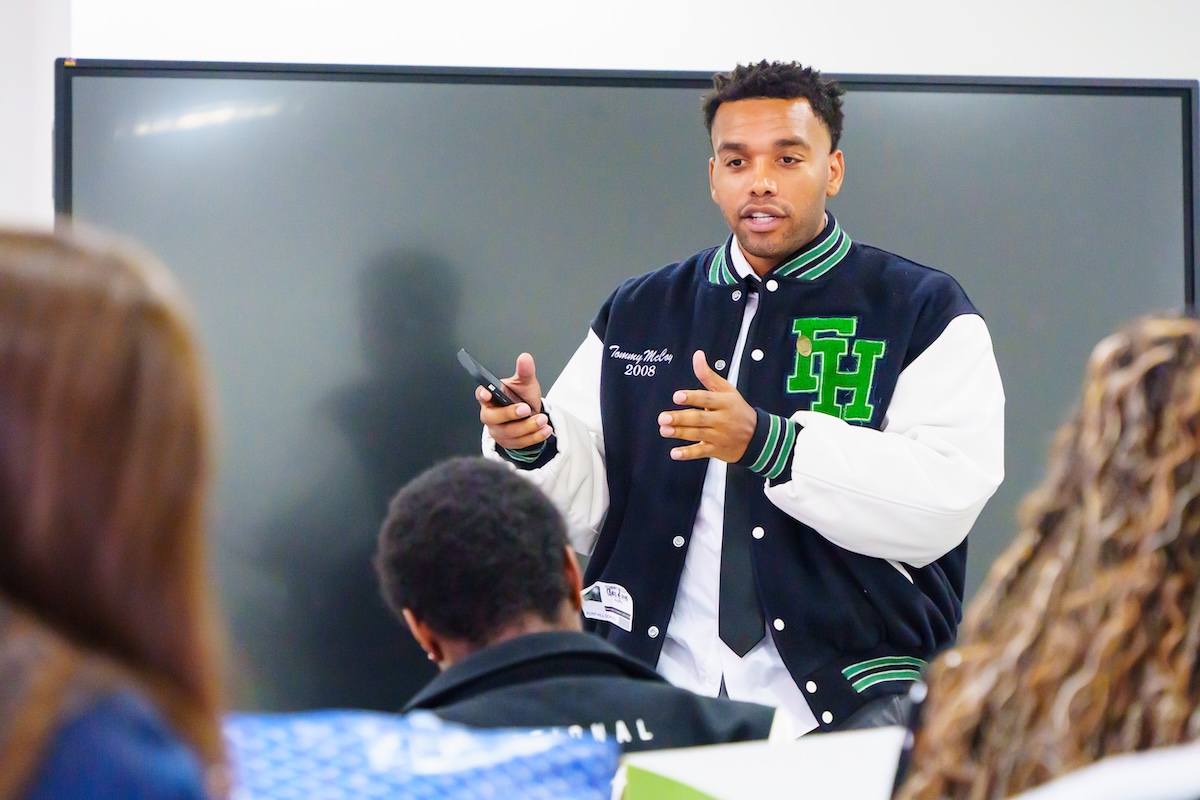
Entrepreneurship didn’t just open career doors for Tommy; it unlocked a commitment to mentorship. It was that spirit of giving back that brought him back to Flint Hill in November for the inaugural Real World Ready: Alumni Playbook speaker series, envisioned by the school as a way to connect alums with current Huskies to offer real-world advice and inspire future career paths.
To help the students evaluate a career in entrepreneurship, Tommy guided them through a self-assessment on the four key traits of business founders: action-oriented, practical, social, and driven by purpose. “You need to understand your own strengths and weaknesses and those of others who you partner with,” he advised. Any area they rated lower than a 7 out of 10 could be addressed — Tommy suggested — by either skill-building or strategic partnership. “If you are a practical person but not action-oriented, team up with someone who is.” It’s a strategy that Tommy says helps in business and in life.
Action-oriented is the entrepreneurial trait Tommy rates highest within himself — a value instilled by his parents. “I grew up with parents who said if they were going to do something, they did it,” he remembers. That action-focused ethos is also apparent in his morning routine. An early riser, Tommy sets his alarm for 5:30 a.m., starts every day with prayer, is in the gym by 6:15 a.m., reads something foundational to him, studies Spanish, and plays some competitive bullet chess — all before his workday begins.
In fact, he credits bullet chess — a fast-paced online version of the game — with helping to reconfigure how his brain works and how he analyzes problems. “It’s absolute chaos,” he says. The game forces players to problem-solve in a matter of seconds. “One mistake typically leads to failure,” Tommy explains. He draws a parallel to the professional world, where things happen in an instant. “How quickly can you adapt, respond, and execute to mitigate risk?” This strategy can help you gain a competitive advantage, increase resilience, and problem-solve effectively across various domains.
Beyond training his own business reflexes, Tommy also uses chess as a mental roadmap for mentoring new entrepreneurs, inviting them to play as a way to “break the ice” and to introduce his core philosophy for business success: “Get yourself out there. Start. And do it in a coordinated effort.”
Tommy has always been naturally oriented to helping others. “I’m an educator at my core,” he says. This was evident even during his years at Flint Hill. His Senior Project involved teaching and mentoring children with special needs at Accotink Academy in West Springfield, Va. Two years ago, he paid that meaningful experience forward, serving as a Senior Project mentor for Gideon Bobb-Semple ’23, helping Gideon navigate the early stages of his fledgling online bakery, Gid’s Baked Goods.

Tommy knows the power of mentorship because he’s benefited from the guidance of others. “When you have goals like mine, you need people who will roll their sleeves up and fight for you, go to bat for you, defend and inspire you.” Every day, he talks to mentors from all around the country. Some of them are leaders he met via Flint Hill, including David Boyer, the father of his friend Tess Boyer ’08, and Gary Rappaport P’09,’17, H’23, a former FH board member.
Coridor.ai is Tommy’s newest venture. He and his team build “Coridors” — dynamic synthetic personas purpose-built for market research. These AI research participants are infused with human neuroscience principles and approximate the sentiments of real study respondents, so teams can quickly pressure-test ideas, refine survey questions, and narrow target scopes before running studies with actual people. By helping researchers get closer to their true target audience up front, Coridor cuts down on recruitment time and costs while making traditional market research more focused and effective.
Identifying problems and filling needs comes naturally to Tommy, and he’s not afraid of failure or of trying things. “Some things work, some things don’t,” he says, “I learn and I use that experience on the next thing.”
His affinity for chess may guide his decision-making, but it’s his experience on the football field that defines his management style. In football, the outcome is dependent on the team, much like in business. Tommy calls managing people “the most complicated part of business.” His time playing football for FH and for JMU drilled in him the importance of coordinating multiple players toward a single goal and he’s been sharpening that skill ever since.

Looking out onto the playing fields at FH brought back fond memories. He stays in touch with several alumni and has hosted the FH Alumni of Color Reception more than once. He hopes that his involvement inspires people to build things together and create new relationships and that it motivates others to do the same. He says, “I do it because, hopefully, collectively it impacts a lot of lives.”
A nephew — a future Husky, he hopes — was born the day Tommy visited FH, making him an uncle for the 17th time. Family and faith remain Tommy’s main priority and the foundation of his work. They are the lives he cherishes most deeply. He takes pride in working alongside them and offering mentorship when needed.
Whether he’s tackling a new venture, mentoring a fellow entrepreneur, or returning to the sidelines of Flint Hill, Tommy’s focus remains fixed on collective achievement. His journey is a testament to his belief that when you combine methodical thought with the courage to start, the impact you have on others — and on the world — is the ultimate measure of success.