



The thousand miles between Northern Virginia and Coral Gables, Florida, represent more than just a change in climate for Melina Kalamatianos ’24; they mark her transition from a dedicated student to an aspiring global strategist.
Building on the academic foundation she started here at Flint Hill, she is now focusing her studies at the intersection of language and political history. As a double major in French and International Studies at the University of Miami, Melina is connecting her study of French culture and history to a future seat at the table of global diplomacy.
Growing up in a Greek-speaking household, navigating multiple cultures was second nature to Melina, but learning French in Middle School proved a bit of an academic hurdle. “I loved learning French because it pushed me in a way I hadn’t been before,” she recalls. “Having Greek under my belt gave me the confidence to dive in; I felt like, ‘If I can do that, I can do this.’”
In 8th grade, she signed up for a spring break trip to Montréal and Québec City. That immersion experience sparked a momentum that never faded. By senior year, Melina had quite literally run out of French classes to take and spent her final semester as a Husky in an Independent Study, deconstructing France’s remarkable history of protest movements.
It is a topic she has mastered so thoroughly that, for two years running, she has been invited back to Mrs. Goldstein’s French IV classroom as a virtual guest lecturer. Her presentation, Pourquoi les Français protestent-ils? (Why do the French protest so much?), educates students on why France remains a global model for collective dissent.
Melina highlights French movements like Mai 1968, where student and worker strikes paralyzed the nation and forced immediate government concessions, and the Yellow Vests, a highly visual and successful protest movement from just a few years ago.
“I wanted to debunk the stereotype that the French just protest for the sake of it,” Melina explains. “In reality, it is central to their national identity.”
While she finds it daunting to present to students whose shoes she was in just a few years ago, she values the chance to show them how language and social science intersect. “I’m merging my two disciplines — politics and language,” she says. “If I can convince them that you can mix French and something else, then I’ve succeeded.”
Melina says the academic environment at Flint Hill truly set her up for success in college. “My French classes were exactly what university is like,” she says. “Mrs. Goldstein taught me how to turn off the English side of my brain and truly immerse myself in the language.”
Beyond the academic prep, it was the personal investment from Mrs. Goldstein that truly impacted Melina’s trajectory into French studies. “If she wasn’t my teacher I wouldn’t be as into it as I am today,” Melina asserts. “She put some much into me,”
Mrs. Goldstein says she saw Melina’s deep, dual commitment to both language and global affairs early on. She remembers Melina as a student who didn’t just study French as a requirement, but as a tool. That years-long dedication was officially recognized during senior year, when Mrs. Goldstein presented Melina with the school’s prestigious French award. “I remember getting that award was the most rewarding feeling ever,” Melina recalls. “It was like my hard work was paying off.”
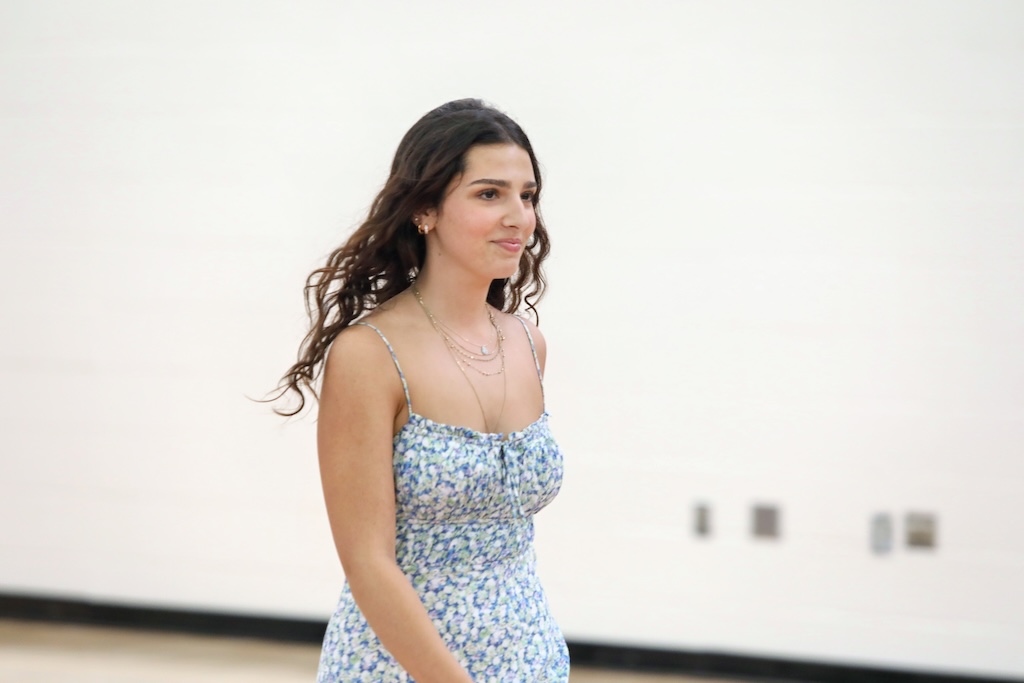
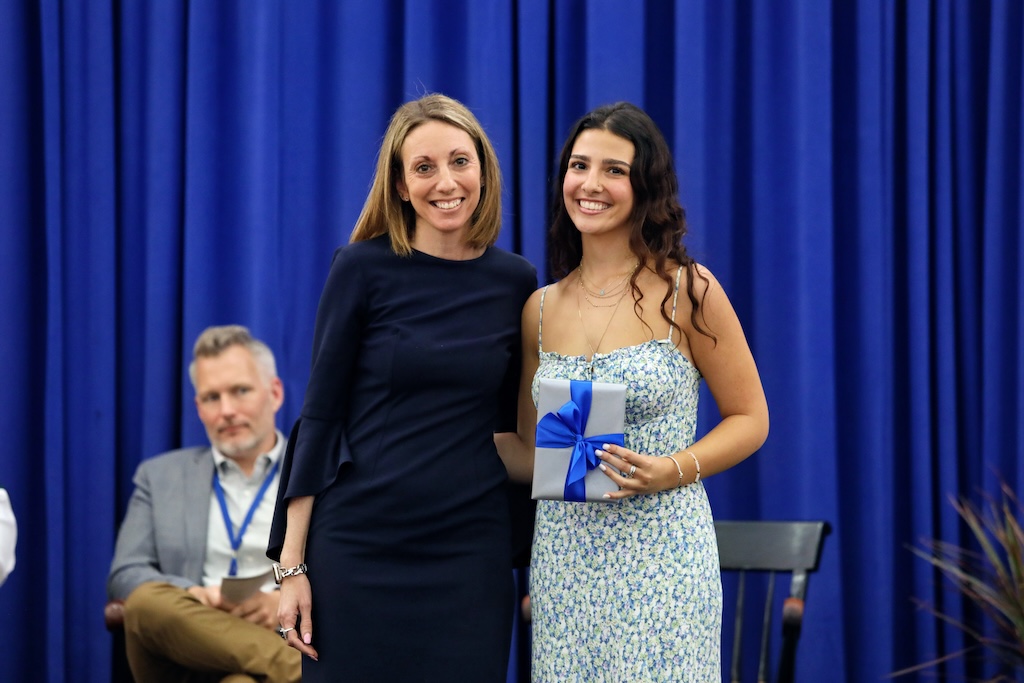
The moment captures the unique teacher-student bond a close-knit community like Flint Hill affords. For Melina, that feeling of being seen and celebrated by her teachers and classmates gave her the confidence she needed to branch out into a much wider world.
“I’m glad that Flint Hill was the size it was,” she reflects, noting how the school’s scale allowed for the kind of deep-rooted connections that have become lasting lifelines. “I still talk to Hayley (Lublin ’24) every day,” she says as she lists off another half-dozen Huskies she stays in close contact with.
To balance her heavy academic load, Melina has found a high-energy outlet as an on-campus spin instructor. “It’s my alter ego,” she says, recognizing it as another meaningful risk she’s taken in college.

She’ll need that stamina as she pursues her path toward the Foreign Service. Melina’s journey is a testament to the fact that studying a second language is more than just a graduation requirement; it’s a bridge to understanding history and culture and the framework for making a tangible impact on the world.
Merging her Husky foundation with dedication and ambition, Melina is proving that it’s not just about speaking a new language, it’s about starting a new conversation.